Summer Bridge Program
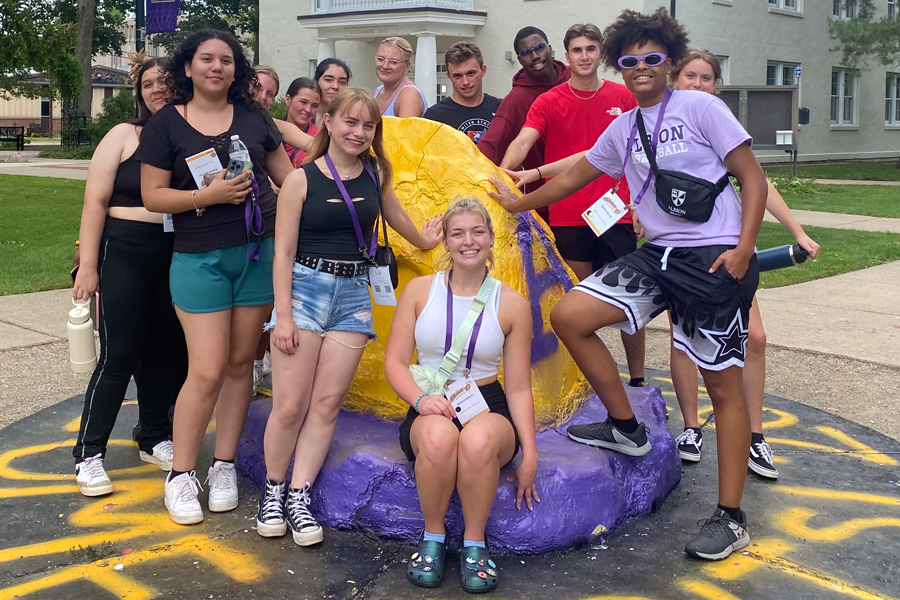
Albion College is offering a unique four-week Summer Bridge experience for first-year students from July 20-August 17.
Participants who enroll and complete the Summer Bridge earn one free Albion College unit and free textbooks for their first semester!
Here are just some of the highlights:
- Earn one of the 30 units needed to graduate from Albion unit in just four weeks! (All courses count towards graduation requirements.)
- Choose from one of five innovative courses; each course will introduce you to contemporary topics in the specific field and take you beyond the classroom to explore museum exhibits, engage in service projects in the community, collect and present data, and so much more!
- The summer bridge is a residential program, with all participants living on campus and engaged all day, Monday through Saturday. Room and all meals are provided.
- Take a variety of field trips and outings with fellow students.
- Upon successful completion of the Summer Bridge, you will earn one unit towards graduation and free Brit Books (Albion’s textbook rental program) for your first semester at Albion College!
What’s more? Participants will gain early access to campus resources and programs, building connections with faculty and staff and your Bridge cohort, and begin to map out a plan to meet your academic and career goals.
Incoming students must submit their enrollment deposit (deadline: June 1) and secure their spot in the Class of 2030 before enrolling in the Summer Bridge.
Submit Your Enrollment Deposit
Summer Bridge 2026 Courses
July 20-August 17
Please note that class seats are limited and available on a first-come, first-served basis. Our courses typically fill up quickly every summer, so we encourage early registration to secure a spot in your preferred course.
ENGL 189 – Vanishing Archives: Preserving Memory in a World That Won’t Stand Still
 Faculty: Mariane A. Stanev
Graduation Requirement: Textual Analysis mode; Ethnic Studies category
Summary: If you love museums, storytelling, photographs, and the tales objects can hold, this course is for you! In ENGL 189, we treat our town and campus like a living collection and ask: What gets remembered, what gets displayed, what disappears, and who decides? Using local spaces and collections as our classroom, you will learn to read archival documents, objects, buildings, and artworks as texts. Through visits to the city archives, the Gardner House Museum, campus collections and other regional institutions, you will trace how community stories are saved, interpreted, and sometimes overlooked, including the diverse ethnic histories that shape the area.
This interdisciplinary, public-facing textual analysis course runs through a real-world public humanities scenario: in small groups, students develop the research, interpretation, and practical requirements for a museum-style gallery display. For the final project, teams create an interpretation for a chosen object or location, including a label grounded in textual evidence and a display plan. Your work becomes a class gallery exhibit at the Bridge symposium.
CHEM 189 – Chemistry of Baking
Faculty: Kevin Metz
Graduation Requirement: Mode of Scientific Analysis (MSA)
HIST 189: Playing History: Cultures in Conflict in Early America
Faculty: Marcy Sacks
Graduation Requirement: Ethnicity category (YEH)
Summary: This course introduces students to the formation of a multicultural world in early America – before the United States became a country. Europeans, Africans, and indigenous people found themselves in conflict (and sometimes cooperation) with one another. Their interactions shaped the creation of a new nation in 1776. Using two immersive role-playing simulations, students will become participants in the tumultuous life of the British American colonies.
In Bacon’s Rebellion, 1676-1677: Race, Class, and Frontier Conflict in Colonial Virginia, students will go on a historical journey into the origins of race-based slavery in America. Next, in Forest Diplomacy: Cultures in Conflict on the Pennsylvania Frontier, 1757, students will participate in peace negotiations between Delaware Indians and Euro-descended Pennsylvanians who are embroiled in a vicious and destructive war in the region.
By engaging in role play, you will experience history rather than simply learn it. Along the way, you will develop your skills in public speaking, writing (speeches and newspaper articles), negotiations, strategizing, and (above all) critical thinking.
This course fulfills both the ethnicity category requirement and a social sciences unit of the core curriculum and one unit of a History major or minor.
IDY 262 – Arts Integrated Learning
 Faculty: Kyle D Shanton
Graduation Requirement: Artistic Creation and Analysis mode (MAC)
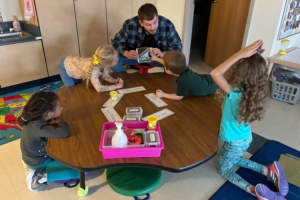
Summary: In this course you’ll have various opportunities to explore, rehearse, and enact various ways to make learning academic content in literacy and mathematics accessible, engaging, and meaningful. This happens by using different kinds of art as tools for learning as well as forms for representing learning. You will workshop and explore five arts (i.e., 2-D visual, 3-D visual, dance-movement, instrumental-vocal music, and drama theater) with peers and the professor. You’ll also participate in experiential learning serving small groups of children and their families from local communities as they visit Kids N Stuff (KNS) Museum in downtown Albion. Then you’ll prepare and present a synthesis of your learning to integrate the arts at the Summer Bridge Symposium. All are welcome, so join Profe K and your peers!!
BIOL 189- Biology for Non-Biologists
Faculty: Marcella Cervantes
Graduation Requirement: Scientific Analysis mode (MSA)