Remembering When: Wesley Hall went co-ed
The early 1970s were turbulent years.
The U.S. Supreme Court upheld busing as a means of achieving racial desegregation, Marvin Gaye released his socially conscious anthem “What’s Going On?” and an estimated 500,000 anti-Vietnam war protesters marched on Washington, D.C.
Closer to home, on the Albion College campus, tensions were running high for a different reason. There was a housing crunch and students were demanding the college approve a plan to loosen several housing restrictions, including allowing men to reside in Susanna Wesley Hall, which had exclusively housed women for more than four decades.
The proposed housing changes also included using annexes on a lease basis to seniors, eliminating upperclassmen resident assistants, providing single rooms in residence halls, and giving fraternities more responsibility.
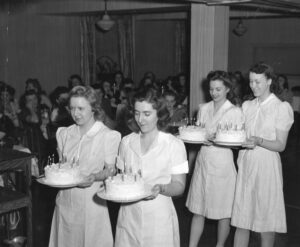 Hoping to pressure the college’s trustees, in April of 1970 male students held a sleep-in at Susanna Wesley Hall. That same evening, 700 students met with trustees, administrators, and faculty in heated discussions in Kresge and Baldwin dining halls.
“The sleep-in was to demonstrate student concern out of a deep frustration because of a lack of a communication or response from going through channels,” Stuart Dykstra, a junior from Grosse Pointe, told the student newspaper.
The proposed housing changes (which had been recommended by a presidential ad hoc committee) were also endorsed by an overwhelming majority of the college’s resident advisors.
“We believe that Albion students are mature enough to accept the responsibilities of living in an open housing situation,” a letter from the resident advisors read.
A celebrated start
Susanna Wesley Hall was completed and dedicated in 1926. The East and West Halls were added later. The project’s price tag (paid by an anonymous donor) was $200,000 for construction and $25,000 for furnishing.
Designed by Detroit architect Marcus R. Burrowes, it was built to house the 200 women who attended Albion College. The total enrollment of the school was 476. It was the first building on campus dedicated to housing.
Named after the mother of John Wesley, the founder of Methodism, it was soon nicknamed “Susie.” Its dedication service attracted students, faculty, and Albion residents, some of whom marveled at its huge wing-backed chairs, oriental rugs, and heavy draperies. The cafeteria resembled a banquet hall, complete with white linen tablecloths, mahogany chairs, and black Belgian marble terrazzo floors.
Residents were required to learn the dormitory creed: “We believe in the principles of Susanna Wesley; in freedom of opinion, in religious education, and in knowledge of the world about us.”
A decision is made
In May of 1971, Albion approved a new housing program proposed by the Student Senate. The biggest change was that Susanna Wesley Hall would include a men’s residence and would be renamed Wesley Hall. Seaton Hall, which has been a freshman men’s residence, would be converted into a living unit for upperclass women.
The change cleared the way for some men to move into Wesley Hall that next fall. That included Gary Wright, a freshman from Swartz Creek. “Other than the nickname ‘Susie’ and the pink walls and white wicker furniture in the hall lounges, living here in Wesley is great,” Wright said. “It’s fun eating together and just having the girls around.”
Marti Arnold, a freshman from Fraser, added, “I like being all together, having a feeling of belonging,” she said. “That’s the way Wesley Complex should be–natural and relaxed. We don’t know how lucky we are.”
Linda Scalcucci, head resident of East Hall, said most early reports about the new setup were positive. “The students are accepting their responsibilities well and seem to thrive in the casual, more-free living environment,” she said. “Some parents were a bit concerned about the setup of Wesley Complex, but there have been no negative reactions so far.”