Rebooting the college’s relationship with Albion
As a tour guide for Albion College’s Admissions Office, Larissa Botega ’27 is quite at home leading conversations. Recently, Botega spent several weeks fine tuning her listening skills.
As part of her Foundation for Undergraduate Research, Scholarship, and Creative Activity (FURSCA) project, Botega (an international student from Brazil) interviewed members of the Albion community as well as college faculty members. Her goal was to enhance communication between the college and the Albion community to create more experiential learning opportunities.
“My main goal is to make [experiential learning] accessible to every student on campus,” she said.
What she found is that although there are numerous opportunities for Albion students to engage with the community, along with no shortage of ideas from the college, there are significant hurdles in place–communication at the top of that list.
“As Albion College advances our strategic priorities around innovating the curriculum and experiential learning for all, Larissa’s FURSCA project really delved deeply into how more strategic and intentional communication between the college and community could advance these aims,” Professor of Economics and Management Vicki Baker said. “As part of her research, she attended community meetings and other Albion College Community Collaborative (AC3) presentations open to the public. She was able to hear and learn more about the needs of community organizations and ways partnerships with programs like AC3 could advance those needs.”
“Through these meetings, and one-on-one meetings with key stakeholders in the community and on campus, Larissa was also able to learn more about past institutional practices that were effective as well as research best practices in the field to help craft recommendations the college could advance,” Baker said.
Building trust and listening skills
According to Botega, one of the biggest obstacles to more experiential learning opportunities in Albion is fractured trust between the community and college stemming from past issues, which is compounded by the polarized atmosphere within the community.
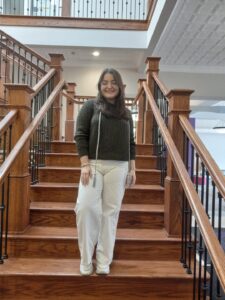
Larissa Botega
“These factors contribute to a reluctance or unpreparedness among community members to embrace some of the experiential learning initiatives proposed by the college,” she said.
Botega’s interviews with faculty members revealed there are an abundant number of innovative ideas for experiential learning, yet building and sustaining productive relationships with community partners has proven challenging. Issues preventing this include disparate operational schedules of local businesses, management styles, or sometimes a lack of mutual interest.
“Moreover, both the college and the community face economic hardships, compounding the challenges,” Botega said. “While the college possesses abundant human capital and enthusiastic stakeholders willing to contribute their expertise, the community’s primary need often revolves around financial resources, which the college cannot readily provide.”
Moving forward together
So how does a college hoping to provide meaningful experiential learning opportunities and a community with great needs move forward? Botega suggests letting the community take the lead.
“The most prudent strategy moving forward appears to be patiently waiting for the community to express its needs and desires for collaboration rather than imposing initiatives prematurely,” she said. “Building a strategic framework that facilitates open communication and solicits community input will be crucial.
Botega suggests establishing quarterly meetings with community stakeholders, revitalizing a college newspaper with wider community distribution, or implementing an accessible email or form for community members to submit requests. She believes by nurturing these channels of communication and engagement, the college can cultivate a receptive environment where collaborative projects can organically emerge based on genuine community interests and needs.
“We need to shift from ‘doing for’ the community to ‘doing with’ the community,” Botega said.
Baker said Botega’s FURSCA project has had an immediate impact and has informed discussions at the academic-cabinet level. “I am really proud of the work she has done, and will continue to do, as part of her summer 2025 FURSCA project,” Baker said.
Larissa Botega is a sophomore pursuing a double major in economics and computer science, with a minor in data analytics and a concentration in the Gerstacker Business Institute. She is also a member of the Honors Program. Larissa actively contributes to campus life in various roles, including serving as a tour guide, global ambassador for the Admissions Office, student manager for the Office of Campus Life, and an intern with the Albion College Community Collaborative. She is a member of the Omicron Delta Epsilon honor society in the Economics and Management Department, as well as the Union Board. Larissa also serves as the president of the International Student Union and has been recognized on the Albion College Dean’s List since 2023.