Asking and answering the ‘weird’ questions
The study of philosophy is at the heart of the liberal arts tradition, and with 19 years at Albion, Professor Jeremy Kirby may be at the heart of the college’s philosophy department. At the end of the fall semester, Kirby was editing proofs for his forthcoming book on Aristotle and the philosophy of biology, a book he asserts is not just for other philosophers to read.
The Greek philosopher predated Darwin and the molecular revolution by well over 2,000 years, but he “had a lot to say about biology that is still philosophically interesting today,” Kirby said.
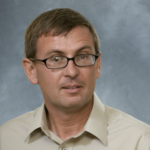 Asking questions, new and old, are also the heart of philosophy, and one of the driving reasons for Kirby’s entire career. “I was a sophomore and had no idea what to expect when I signed up for Philosophy 101 at Weber State University,” Kirby recalled. “Then I learned you could major in asking questions that people think are weird. I was pretty much in at that point.”
As an instructor, Kirby delights in those weird questions, but is equally focused on teaching students how to craft answers. Some students believe philosophy means that any view is as good as the next, Kirby said. “Usually, they’re pleasantly surprised that they have to defend their opinion and see that every classmate’s opinion isn’t as good as the next.”
Following Kirby’s teaching philosophy–that any question can be asked, but not every answer can be valid–it’s easy to see why he says philosophy plays a key role on a campus devoted to experiential learning. First, he credits Professor Emerita Bindu Madhok with encouraging her colleagues to include student presentations as a standard class assignment.
“There’s no profession our students will go into that doesn’t involve advancing an idea on the basis of reason,” Kirby said. “Our department is well-positioned to help students develop skills that will help them with success in their profession.”
And when it comes to what to do you do with a philosophy major or minor, there’s almost nothing Albion students aren’t doing. In the fall of 2025, Albion’s philosophy majors and minors were studying a whopping 17 additional majors.
“Our majors and minors all have one thing in common and it’s curiosity, where they like to keep asking questions at that sort of abstract level,” Kirby said.
Like most of his Albion colleagues, Kirby finds joy both in his research and teaching, with a special enthusiasm for the type of philosophy student he was at the beginning.
“We’re a department that gets a lot of students with no clue what we’ll be doing, and that’s exciting as well,” he said. ”You see the lightbulb come on, you have students saying ‘I’ve been asking these questions my whole life and I didn’t know there was a discipline to do that. It’s cool to turn someone on to philosophy, like sharing a classic rock album.”
Jeremy Kirby’s forthcoming book is titled Aristotle’s Biosphere (Bloomsbury, 2026). He is also the author of The Gamma Paradoxes: An Analysis of the Fourth Book of Aristotle’s Metaphysics (Bloomsbury, 2018).