Albion College receives $65,000 Native American Heritage Fund grant
Whether it’s the Tech-Savvy Seniors program, the Albion Community Gardens, or partnerships with local schools, Albion College continues to form meaningful partnerships with our surrounding community.
One of those partnerships which continues to grow is with the Nottawaseppi Huron Band of the Potawatomi (NHBP) and the Native American Heritage Fund (NAHF) Board, which recently granted the college $65,000 to co-create culturally appropriate exhibits and co-management plans for natural and cultural resources in the College’s Whitehouse Nature Center.
Community curated displays and trail signs will feature the talents of local Anishinaabe artists and communicate two key messages to the public: First, Albion history is Anishinabe history. And second, by restoring relationships we can restore the land.
In total, NAHF has granted Albion College $100,000 in the past two years for this purpose. The title of the co-authored grant is Nado’Wen Wij | Healing Together: Repairing Relationships and Remembering our Shared History.
“Since its inception, the Native American Heritage Fund has been a catalyst for positive change in Michigan communities,” said NAHF Chairperson Dorie Rios, who also serves as tribal council chairperson for NHBP. “Our mission goes beyond financial support. We partner with communities through every step of the process—from education and cultural guidance to implementation—so that changes are not only made, but made meaningfully. These grants help restore accurate representation, uplift indigenous voices, and build stronger bridges between tribes and local communities.”
Since 2020, Albion College’s anthropology and sociology and biology departments have collaborated with the NHBP’s Environment Department and Tribal Historic Preservation Office to develop a course on the archaeology of wild rice in Michigan and design and deploy an innovative tool (wigwasmkek) that braids traditional ecological knowledge with western biology field methods in the study of wild rice (mnomen) ecosystems. Mnomen is the official state native grain of Michigan and holds deep cultural and religious significance for Indigenous peoples of the Great Lakes.
The collaborators have also begun poring through the archaeological and archival records pertaining to the Anishinabe history of Albion–including a 1,000 year-old ancestral site and documents discussing the 19th century “Indian Department” at Albion College (then the Wesleyan Seminary) that enrolled dozens of local Native American students.
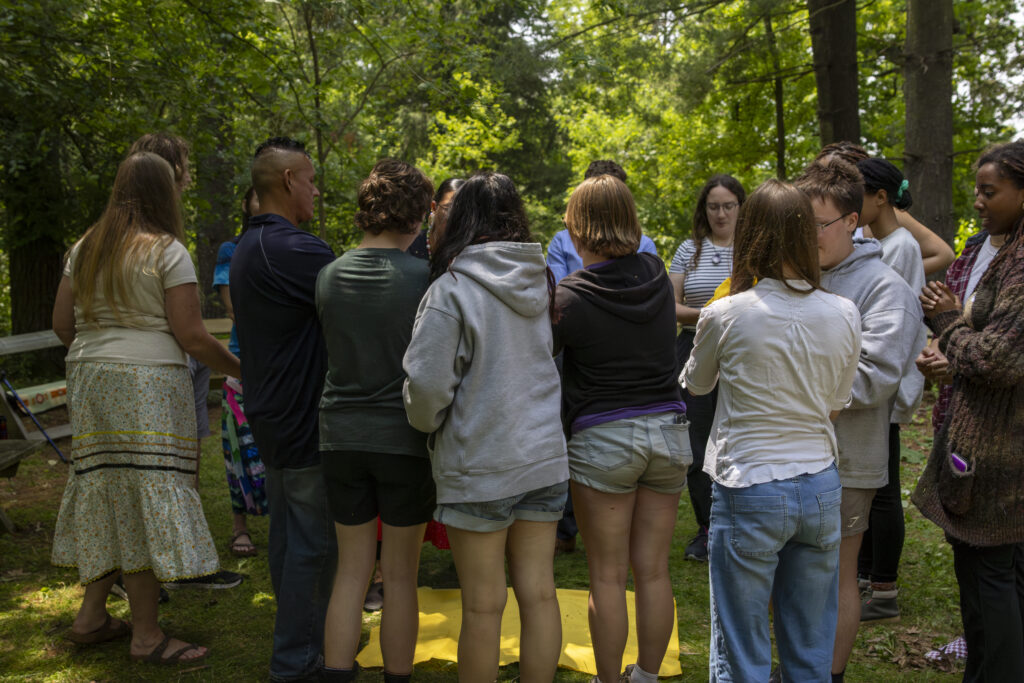
This past summer, representatives from the NHBP and Albion College gathered at the Whitehouse Nature Center for a water ceremony, a pipe ceremony, and a communal lunch of mnomen, bison, maple syrup, corn, squash, beans, a berry parfait, and sweetgrass tea to celebrate their ongoing partnership.
Participants included Potawatomi Pipe Carriers and Water Carriers, employees of the NHBP Culture Department, Environment Department, and Tribal Historic Preservation Office, and their families. Representing Albion College were professors Abigail Cahill (biology), Brad Chase, and Alli Harnish (anthropology & sociology), WNC Manager Misty Brooks and members of the WNC advisory committee, Albion College President Wayne Webster, Albion College Board Member Mae Ola Dunklin, Provost Lisa Lewis, Assistant Provost Vanessa McCaffrey, Assistant Director for Spiritual Life Laura Todd, and students, staff, and faculty from the college’s Center for Sustainability and the Environment.
Associate Professor of Anthropology Alli Harnish, who co-wrote the grant with Tribal Historic Preservation Officer Onyleen Zapata said, “it’s been beautiful, powerful, humbling, and fulfilling to see our two communities come together. We are so grateful to the NAHF for making this important work possible.”
This story originally appeared in the 2025-2026 President’s Report.