The power of a shared story: Rick Smith’s Common Reading Legacy
For Rick Smith ’68, former editor-in-chief of Newsweek, reading has always been more than an academic exercise; it’s a bridge between people, ideas, and generations, reflecting the core of an Albion liberal arts education.
As the endowment of Albion College’s Endowed Richard M. Smith Common Reading Experience (CRE) celebrates its 25th anniversary, we’re reminded of where the program began—with its namesake himself.
By giving every incoming student a shared text to explore in their First-Year Seminar, the CRE creates common ground, encouraging students to engage deeply with ideas, consider multiple perspectives, and build connections with their classmates. It’s an invitation into Albion’s academic culture, where curiosity, dialogue, and critical thinking form the foundation of a student’s journey.
“My interest [in endowing the CRE] was being part of a process that says to a young person, ‘You’re not in high school anymore. This is a different kind of setting. You are required to think more for yourself; express yourself more independently; and engage with material more critically,’” Smith said. “You need to be able to discuss with others your interpretation of a book and be aware that others will see different things in those same pages.”
Finding Albion: The start of a lifelong connection
Smith’s own Albion experience—coupled with his lifelong passion for the written word—drove his interest in endowing the CRE. Though nothing like it existed when he was a student, Albion taught him the very lessons the program now imparts.
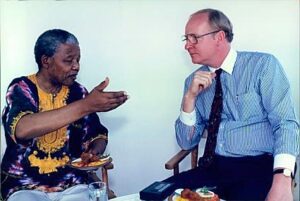
Richard Smith with Nelson Mandela
Smith’s initial knowledge of Albion came through family ties, but ultimately it was a scholarship offer and the college’s liberal arts model that brought him here.
“I had one advantage in terms of my knowledge of [Albion] because my older sister and brother-in-law had both gone there,” Smith said. “I was open minded about various places. I was quite sure I wanted a residential liberal arts college. I looked at a number in the Midwest and I chose Albion because I got a very nice scholarship offer—and it was better than Kenyon.”
When Smith arrived on campus—fourteen years after his older sister did—he had only a vague idea of what he might do in his career (“Something with words, not numbers,” he specified). He didn’t see his path panning out the way it ultimately has.
“I was not one of the kids who started a newspaper on his block when he was eight years old—though I have met quite a few of those in the business,” he joked.
While his career dreams might not have started that young, they certainly took off at Albion. Smith took two journalism classes that proved formative early on. The “quirky” professor who taught those classes and advised The Pleiad was influential in Smith’s interest in journalism–though his gig on The Pleiad wasn’t his first paying journalism job. Prior to joining the college’s student-run publication, Smith had already been writing for the Battle Creek Enquirer.
On The Pleiad staff, Smith served first as a feature writer, then sports editor, and eventually wrote his own sports column. As an upper classman, he was offered the position of editor-in-chief but ultimately declined; newly married with a young child, he was balancing work for the Enquirer, his Pleiad duties, his role as sports information director for the college, and membership in Sigma Nu.
Through his many campus roles, Smith learned lessons about integrity, curiosity, and engaging with others who held different viewpoints—skills at the very heart of the CRE today. Albion, he said, was where he found both his professional calling and his intellectual voice, instilling passions that would later inspire the CRE endowment.
Building a career in words: From The Pleiad to Newsweek
After graduating from Albion in the spring of 1966, Smith went on to Columbia University’s journalism program, noting that he felt “very well prepared” for his graduate degree by Albion’s writing-heavy, discussion-based classes.
What came after Columbia, though, proved to be more challenging.
“There wasn’t a lot of time for hand-holding,” Smith said of his introduction to working for Newsweek. “The audition was not a gentle process.”
The demanding Newsweek “writing tryout” that all young journalists faced when vying for a spot at the magazine was daunting. Smith recalled it as a defining test in his early career: Writing two or three stories a week with little guidance forced him to learn quickly how to identify what made a story worth telling.
The process, though intense, shaped his editorial instincts and his sense of responsibility for the written word–and it led to a 37-year tenure at Newsweek, culminating in his role as editor-in-chief.
After decades spent telling stories that shaped public understanding, Smith turned to philanthropy—continuing to champion voices, this time through opportunity. Today, Smith serves as chairman and CEO of the Pinkerton Foundation—a role that began almost by accident. A casual comment (“You have the world’s best job”) to the foundation’s former chairman led Smith to his second career championing youth opportunity.
Pinkerton’s mission is to support 5,000 internships per year and science mentoring programs reaching 6,000 students—with a 100 percent college attendance rate among participants. Smith reflected on the deep pride he has for fostering youth opportunity and mentorship, mirroring the lessons he learned at Albion about curiosity, rigor, and challenge.
At its core, Smith’s work at the Pinkerton Foundation isn’t so different from what he’s built through the CRE at Albion: Both aim to further young people’s potential and help them develop the skills to find their path—whatever that may be.
“The thread that connects all of our work,” Smith said, “is the hope that a young person will meet the answer to the question, ‘Who has changed your life?’”
Creating the Common Reading Experience
“I don’t think you can look at the Common Reading Experience without looking at the context of the whole first-year experience,” Smith said.
Assistant Vice President for Student Development Kelly Finn, who runs Albion’s orientation program for first-year students, concurred, noting how Albion-O orientation, the First-Year Seminar program, and the CRE work together to lay the foundation for the entire first-year experience.
“If students can walk away from those few days [of orientation] feeling like they’ve built connections with other students, they feel comfortable on campus, and they have a sense of belonging, then we’ve achieved success,” Finn said. “When we set out to plan orientation, that’s really what we have in mind–and that’s directly tied to the vision of the whole first-year experience and the Common Reading Experience too.”
Though the CRE existed before Smith’s endowment, it truly took flight after his involvement, becoming a cornerstone of Albion’s first-year academic experience. For Smith, the decision to endow the program stemmed from his belief in communication, empathy, and the life-changing power of thoughtful dialogue. Twenty-five years later, that legacy endures.
“The hardest thing in academia is to take something away,” Smith joked about the longevity of the program. But the CRE continues for reasons far beyond that—in part because it embodies Albion’s most timeless values. Trends in education may change, but the ability to engage with provocative ideas and communicate clearly will always matter, perhaps even more so in the age of AI.
In today’s divided world—muddied with “information cocoons,” as Smith calls them—it’s easier than ever to avoid opposing views. In that environment, the CRE serves as an antidote: A space to embrace, understand, and respect different perspectives–and to learn how to communicate those perspectives thoughtfully.
Smith said he often finds himself smiling when people suggest that tools like ChatGPT will make writing obsolete.
“There is something fundamental about preparing to write, organizing your thoughts, and then communicating them clearly that will be essential in a post-AI world—and it may be even more important,” he explained. “There will be a lot of people who will not be prepared to communicate effectively and interact with the written word. I think that kind of preparation is every bit as essential today as it was back then.”
Far from an AI-denier, Smith acknowledges that AI technology will reshape much of how we live and learn. But the habits of mind that the CRE instills—critical thinking, curiosity, and empathy—are what allow us to adapt meaningfully to change.
“Clear, well-organized communication is an essential building block for thinking,” Smith noted. “There’s no better place to hone those skills and develop complex thoughts than in a small college classroom.”
“If you’re letting the algorithm do that for you,” he added, “you’re a lesser human being than you can be.”
An enduring legacy
When he looks back on his Albion experience, it’s the paths of most opposition that Smith is most grateful for—not the things that were easy. He carries deep gratitude for the toughest professors–including his Pleiad advisor–who demanded more, cultivating “you can do better” as a lifelong mantra.
Throughout his life, those who challenged him the most, Smith said, were the people who gave him the intellectual courage and moral curiosity to pursue a life built on words, ideas, and community—the same qualities the CRE now aims to impart onto every first-year student at Albion College.
“Reading introduces us to ideas we may never have encountered and makes possible relationships that might not have existed without it,” Smith said.
After 25 years, the spirit that inspired the program’s endowment remains unchanged. The Richard M. Smith Common Reading Experience continues to carry forward its founder’s belief that reading is more than an academic exercise—it is a catalyst for connection, understanding, and meaningful conversation.